Don't Buy the Domain.
The cheapest thing your idea needs is evidence.
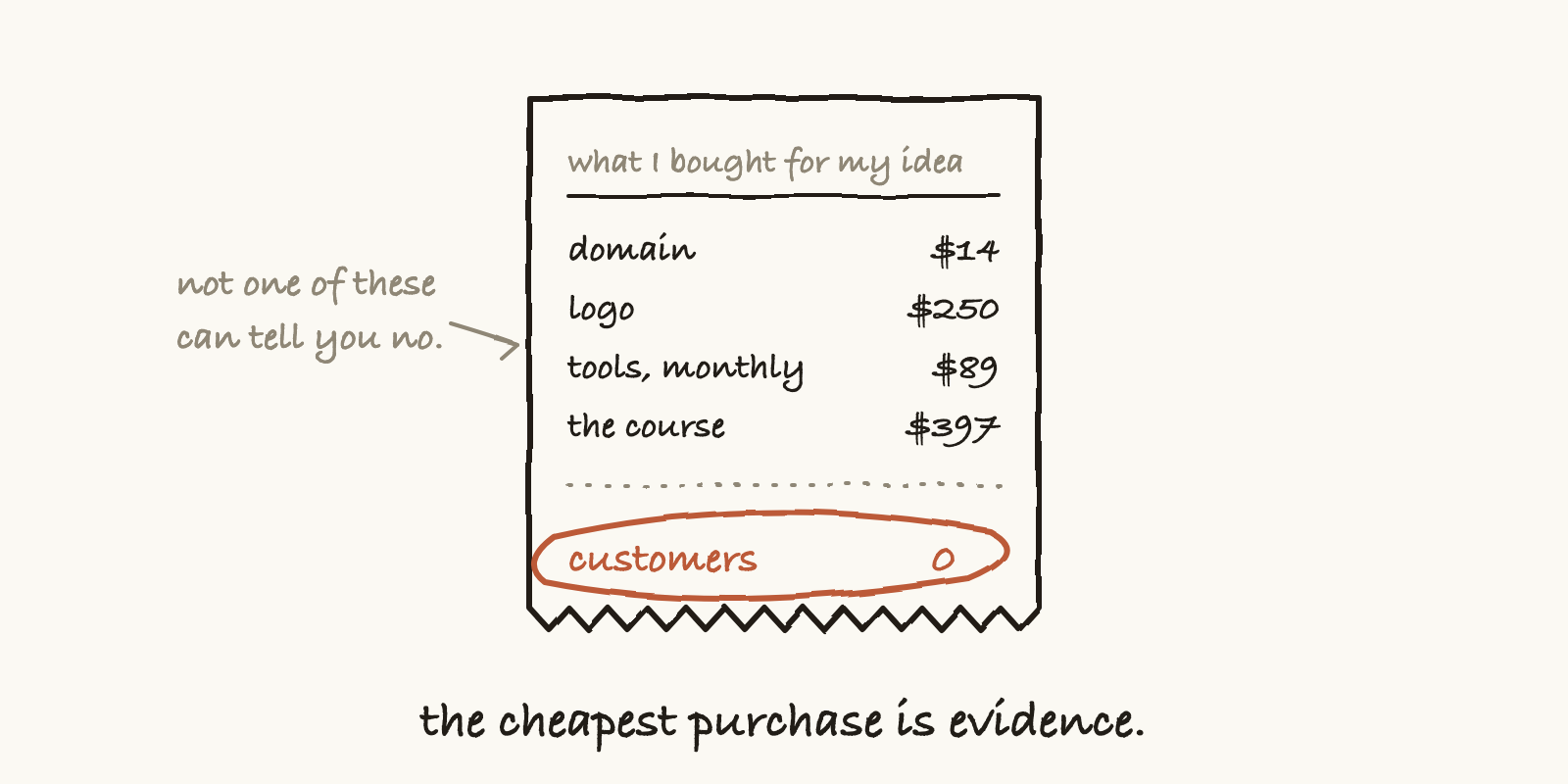
You've bought the domain. Maybe the logo. Maybe a few tools with monthly subscriptions you're trying not to think about. And you still don't have the thing you actually wanted, which is a customer.
I want to talk about why that happens — and why it isn't a discipline problem.
Spending feels like progress
Every dollar you spend on your idea buys a feeling of forward motion. A logo makes the idea look real. A website makes it feel official. A tool promises to make the eventual business run smoothly.
But none of those purchases answers the only question that matters at this stage: will anyone pay for this?
That question is uncomfortable, and everything on the list above is a socially acceptable way to avoid it. Buying a logo can't tell you "no." That's precisely what makes it feel safe — and precisely what makes it worthless as evidence.
One small test beats a hundred hours of planning
Here's the principle I run my own company on: never build anything significant without proof that someone will pay for it first.
-
New offer? Put up a one-page description and drive a handful of real prospects to it before building the delivery.
-
New feature? Sell it before you build it. If nobody bites, you just saved yourself a month.
-
New positioning? Write both versions, show them to real people, keep the one that makes them lean in.
Each of these tests costs days, not months, and almost no money. And each produces the one thing spending can't: a real yes or a real no from someone who isn't being polite.
Decide the pass mark before you see the results
One more rule, and it's the one that separates testing from theater: set the threshold before you run the test. "I'll reach 100 people; if fewer than 5 respond, the message is wrong and I change it."
If you don't commit to the bar in advance, you will move it afterward — everyone does. The test becomes a story you tell yourself instead of a decision you've made. Write the number down first. Let the result be allowed to disappoint you. That's the entire discipline. (It's also how we run iFactor internally: every bet gets written down as a number, with the pass mark committed before the data arrives.)
What to do instead of spending
Take the real problem you think you're solving and make the smallest possible offer around it: one page, one promise, one price, one way to say yes. Put it in front of ten real people who have the problem.
Their reaction — not your logo, not your tool stack — tells you whether you have a business or a hobby with expenses.
And when the small test says yes, Skip the Logo. is the 30-day sequence that turns the yes into your first paying customers.
Start with a diagnosis, not a purchase
If you've already built the website, it's actually an asset for this — not because of what it sells, but because of what it reveals. Your site is a written record of every assumption you've made: who the customer is, what they want, what they'll pay.
That's what iFactor reads. Run the free scan and it will tell you what your pages are actually claiming, which assumption is doing the most load-bearing work, and the single next move worth making — before the next dollar leaves your account.
The cheapest thing you can buy for your idea is evidence. Start there.
Written by Mboso