Skip the Logo.
30 days to a paying customer.
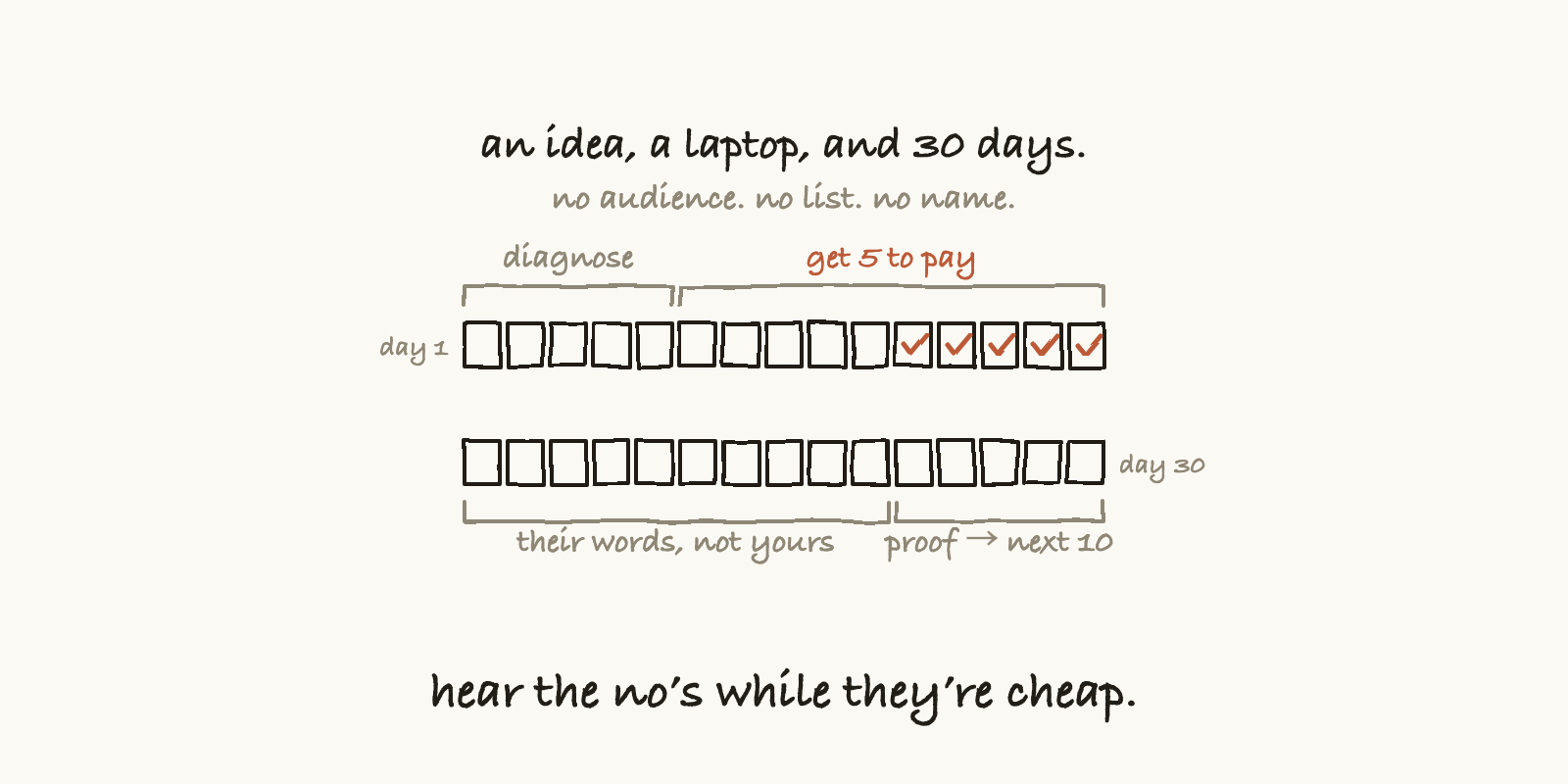
Here's a thought experiment I come back to constantly.
If I had to start over tomorrow — no audience, no name recognition, no email list, no customers — and all I had was an idea and a laptop: what would I actually do?
Not "what does the internet say to do." What would I, knowing what a decade of building has taught me, actually do with 30 days?
Here's the honest answer.
Days 1–5: Diagnose before you touch anything
The first week isn't for building. It's for figuring out who has the problem and where they already are. Not "my target market" — specific people, actively feeling the problem, reachable this week.
And before contacting anyone, I'd write down my assumptions as numbers: how many people I'll reach, what fraction should respond, what a response is worth. Vague plans can't fail — that's what makes them worthless. A plan with numbers attached can fail fast, which is exactly what makes it useful.
Days 6–15: Get five people to pay
Notice: pay. Not "express interest." Not "join a waitlist." People lie in surveys — kindly, politely, constantly. They'll tell you they'd absolutely pay $100 a month, and then ghost the moment money appears. The only customer data that can't lie is a payment.
So I'd make the simplest possible version of the offer — no brand, no polish, an ugly page and a checkout link — and ask real people for real money. Five paying customers is a small number with enormous information density: it proves the problem is real, the promise lands, and the price survives contact with a wallet.
Those five have a name, by the way — Test Buyers — and a completely different job than every customer who comes after them.
Days 16–25: Iterate on their words, not my ideas
Now I'd have something most founders never get: feedback from people who actually paid. I'd deliver the thing and ask three questions:
-
What almost stopped you from buying?
-
What convinced you to say yes?
-
What's missing that would make this ten times more valuable?
Their answers — in their exact words — become the positioning, the page copy, and the roadmap. Not my clever ideas. Their language. Every strong page you've ever read was quarried out of customer sentences, not brainstormed in a doc.
Days 26–30: Use the proof to get the next ten
Five paying customers and their results are all the material a simple case study needs: here's who they were, here's what changed, here's what they paid. Want the same? That's the entire growth engine at this stage. No automation, no "content strategy," no six months of audience building before the first dollar.
Test fast. Learn fast. Keep what survives contact with reality.
The part nobody says out loud
The reason founders skip this sequence isn't laziness — it's that building feels like progress and asking feels like risk. Six months of building is six months of never hearing "no." But the "no" you avoid in month one doesn't disappear; it compounds quietly until launch day delivers all of them at once.
The post-mortems agree. In CB Insights' running analysis of why startups fail, "no market need" has sat at the top of the list for a decade — cited in a third-plus of failures, edition after edition (CB Insights). Those founders didn't skip the work. They skipped the asking.
The 30-day version front-loads the "no"s while they're cheap.
Where your website fits in this
At every step of that sequence, your website is the written record of your current assumptions — who you think the customer is, what you think they want, what you think they'll pay. Which means it can be read like a diagnostic.
That's what iFactor does: scan your site, and it will tell you which stage you're actually in, which assumption your pages are betting on, and the single next move with the most leverage. It's free, it takes about a minute, and it's a much cheaper way to hear the first "no" than six months of building.
Still at the itching-to-spend stage, cart full of tools and domains? Don't Buy the Domain. is the $0 version of week one.
Start small. Start now. Thirty days is enough to know.
Written by Mboso