Pull. Pray. Repeat.
Why most founders sell inconsistently — and the sequence that ends it.
Let me ask you a question most founders can't answer:
Do you need Test Buyers or Cornerstone Buyers right now?
If you're not sure, keep reading. This distinction explains more about why sales feel random than any tactic you'll try this year.
There are two completely different types of customers
Your business needs different customers at different stages. They serve different purposes. They require different strategies. And if you mix them up, you can waste months — sometimes years — spinning your wheels.
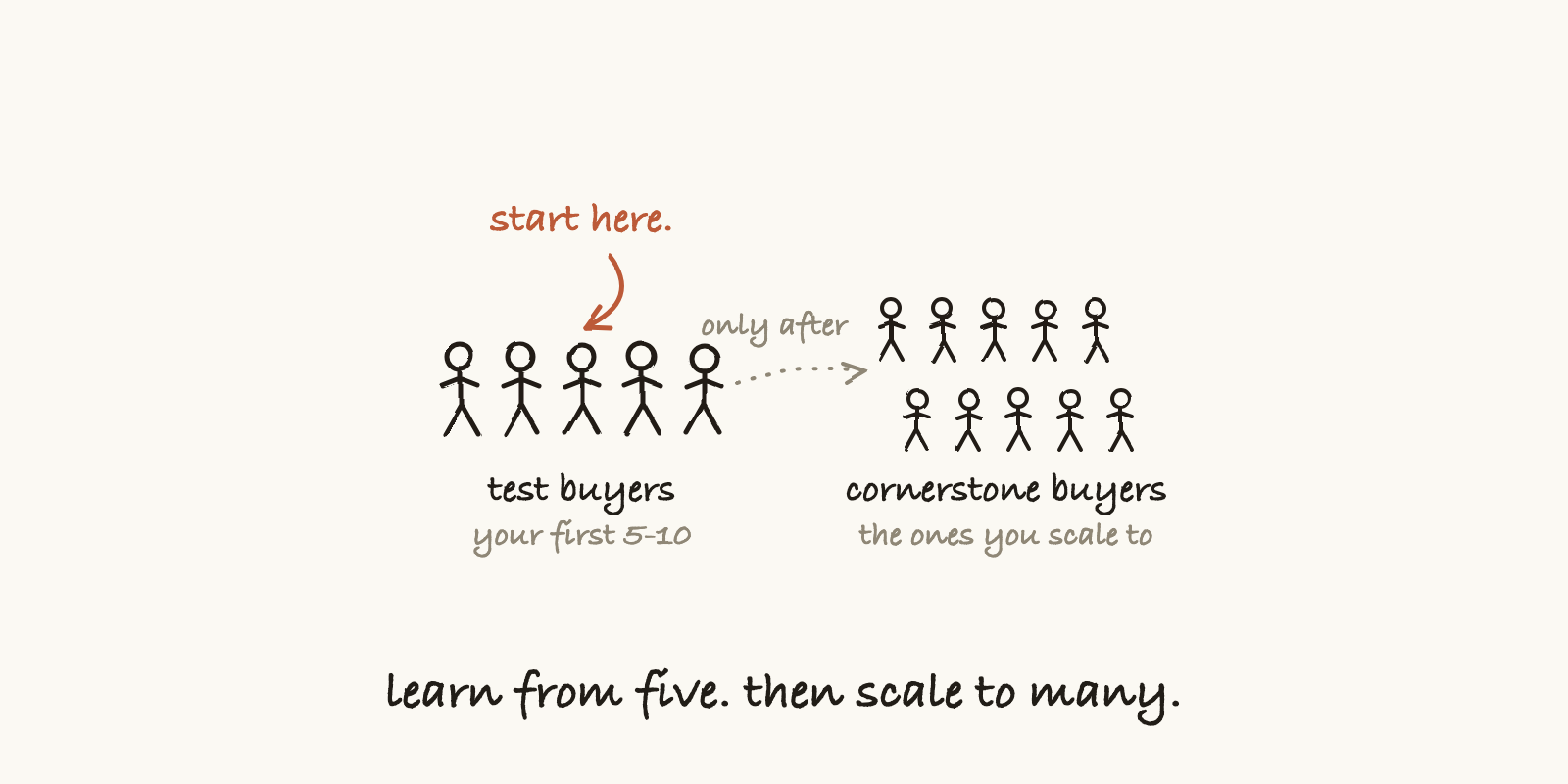
Test Buyers are your first 5–10 paying customers. They are not just revenue. They're validation. Test Buyers tell you:
-
whether your core idea resonates,
-
what your positioning should be,
-
what price people will actually pay (not what you hope they'll pay),
-
which objections come up every time,
-
which features matter — versus which ones you think matter,
-
and the exact language your customers use to describe their problem — the raw material for copy that converts.
Most importantly: they stop you from spending six months building the wrong thing.
Cornerstone Buyers are the customers you scale to. They come from a repeatable system. They're predictable. They're how you get from a handful of sales to a real, compounding business.
Here's the part that matters: you can't effectively get Cornerstone Buyers until Test Buyers have taught you your positioning, your message, and your price. The sequence isn't optional.
What happens when you skip straight to scale
You guess. At everything.
You guess what to build. You guess how to position it. You guess what to charge. So you spend months building on assumptions — and then you launch to crickets.
Now you can't even diagnose the problem, because everything is a variable. Is it the product? The message? The audience? The price? You tweak things at random. A sale trickles in here and there, but there's no pattern — because there is no pattern. You're still guessing.
That's what "sales feel random" actually means: it's not bad luck. It's a missing diagnosis.
The three situations founders are actually in
Every founder I've worked with is in one of three stages, and each one needs a different move:
-
Idea Only — no paying customers yet; not sure anyone will pay. Your job is Test Buyers, full stop (here's the 30-day version of that job).
-
Built But Not Selling — the product exists, but sales are random. You skipped the Test Buyer lessons; you need to go back and collect them.
-
Customers But Plateaued — the offer is proven, but growth stalled. Now you're in Cornerstone territory: systems, channels, repeatability.
Most founders are in stage 1 or 2 but act like they're in stage 3. They build funnels, run ads, and start content strategies before ten people have paid and explained why. That's backwards — and it's not a work-ethic problem. It's a sequencing problem.
How to find out which one you are
You can diagnose this in an afternoon. Look at your last ten genuine sales conversations (if you don't have ten, that's your answer already). Ask:
-
Can I predict which prospects will buy? If not, I don't understand my buyer yet — Test Buyer stage.
-
Can I state, in my customer's own words, the problem they hired my product for? If I'm paraphrasing from my own head, Test Buyer stage.
-
Do new sales arrive without me personally pushing each one? If yes — and only then — Cornerstone stage.
There's even a number for the crossing. Sean Ellis's product-market-fit test asks what percentage of your users would be "very disappointed" if you disappeared: 40% is the line. Superhuman famously measured itself at 22% and built a whole engine to cross it (First Round Review). Below the line, you're still learning from Test Buyers — no matter how good the product feels.
Your website usually gives the same diagnosis, because it's a mirror of your assumptions: a homepage written before Test Buyers speaks your language; one written after speaks theirs.
That's exactly what we built iFactor to read. Run the free scan on your site and it will tell you what your pages say about who you think your customer is — and name the next move for the stage you're actually in, not the stage you wish you were in.
Stop guessing. Sequence it right, and sales stop feeling random.
Written by Mboso